Saturday, March 29, 2014

Penance II

Some folks wanted to see beading in action.  I'm taking a break this morning - I'm not as fast as I once was - so I thought I'd post a short video of flaring and then beading ...

Flaring:


And beading:


When I was younger, I could do an entire array of tubes, 250 or so, in a shift.  Now, I'll be fortunate to wrap up this small array in a Saturday ...

Saturday, March 22, 2014

Penance

This is Lent, when popularly, it is thought that one should be giving something up, as in, "I gave up peanut butter for Lent."  As I understand it from the ancients, though, it was about cultivating a deeper desire for Christ, not necessarily giving something up.  Appended to this was the idea of penance ...

Now anyone who has undertaken to build a boat is familiar with penance and suffering ...

The winter was long and deep.  In addition, a trip was made to South America, other responsibilities and vocations were attended to.  Time in the boiler shop was scarce.  I could not spend as much time on the launch as I desired.  The spouse became worried as neurosis set in.  But today dawned warmer with a hint of Spring, and I was free to work in the shop.

As you may recall, faithful reader, I am building three boilers - one for myself and two for friends.  The one was just ninety some tube-beadings away from its hydro-static test.  And so, thinking about my sins and shortcomings, I picked out a flaring and beading tool, hefted Cletus from the air gun rack and made penance on the tube sheet.

Cletus and I are old friends.  He is thirty-five years old.  Together, we must have beaded over hundreds of tubes in six different locomotives; some repeated re-tubings.  Cletus has a slow, long stroke that when throttled is gentle when starting the tube roll, but can build to a chain-gun crescendo when putting the final polish on the roll.

To illustrate all of this for the uninitiated, here are some illustrations:

An array of tubes (not mine); some flared and some beaded:


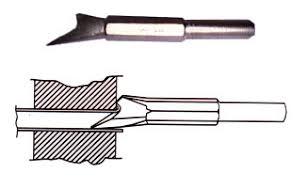
The beading tool:


A boilermaker (no acquaintance), beading tubes with an air gun (not Cletus):


So, after a slow, thunderous morning and afternoon, I finished the one boiler.  I ache and there are few busted knuckles, but my soul is purged and free.  The result from the camera-phone, still flecked with bits of Crisco.

Quiéscite ágere pervérse, díscite benefácere: quærite iudícium, subveníte opprésso, iudicáte pupíllo, deféndite víduam. Et veníte et iudício contendámus, dicit Dóminus.


Sunday, December 1, 2013

Rolling in the Tubes

After some little housekeeping items on the boiler such as chasing threads on the nozzles and cleaning weld-splatter off of hand holes, it was time to prepare for setting the tubes.  Tubes were ordered from Anderson Tube in Hatfield, PA, and the tube sheets were prepared by lightly sanding the holes radially.  Unlike larger boilers where a one-inch variance in tube lengths is not uncommon, all of these holes were within 0.062" of each other, so I cut all of the tubes to the same length.

Tube rolling or expansion is an art far beyond this blogspace.  If you would like to read more about the technical aspects of it, click here.  In short, it involves expanding the tube into the fixed space of the sheet.  Engineers would say that we want to end up with the tube plastic and the sheet holes and ligaments elastic.  After rolling in thousands of tubes in this brief life, there's still a certain thrill to it because it is one of those few areas left to artificers where the ideal balance between over-rolling or under-rolling is a matter of feel.


Here, we're looking at the combustion chamber or back end of the boiler, and the first eleven tubes are rolled in.  The particular expander I'm using has a flaring feature, which I'll explain more about another day.  The goop in the holes is Crisco and while attributing their fine product, I'm sure lubricating tube expanders is something they would not like to be associated with.  But it does the job and doesn't interfere with the heat-transfer welding that comes later.  In some of the holes, one can see the degree that the tube has expanded.  The goop makes the transition look larger than it is - we want this transition to be gradual without sharp edges.  (By the way, some measurements for you technical types:  The holes were bored 1.531", the tubes are 1.50" with 0.095" wall thickness.)

I manipulated the expander by hand, using a T-handle.  That way there wasn't a lot of racket and I could be in my quiet, happy place, feeling the moment of set.  In addition to feel, one sign of a good tube set in sheets this thin (0.375") is just when the mill scale on the sheet right around the hole begins to split into a micro lattice.  If you look at the photo, this lacing appears as a thin, lighter halo around some of the tubes.  That can occur within a sixteenth of a revolution of the expander, so one has to be alert.

The next blog entry will treat flaring and beading the tubes on the front (smokebox) end, and heat-transfer welds on the back (combustion chamber) end.

Saturday, November 16, 2013

Stress Relieved

Here's a shot of the boiler front after stress relieving.  Doesn't it look more relaxed?  Now on to boring two washout plug holes.  The tubes were ordered yesterday.  The activity in the picture foreground is the layout and design for the firedoor ring and the smokebox.

Saturday, November 9, 2013

Ready for the Oven

I remembered the camera this morning before leaving for the shop, which is better than that moment when one thinks, "This would make a nice picture."  First, both sheets received their chamfer at the stay holes for the welding out of the stays.  We have a special 37º bit for the Carlton drill press that makes short work of this.  The stay material was cut to length and before I knew it, the back end was ready for the stress-relieving.  Here's a shot of the back end.  The ends of the stays that were just welded out are the three shiny buttons:


Then the boiler was flipped on its back and the stays welded in on the front.  This might be a good time to explain the other things we're seeing in the photos.  The lifting chain in both photos is threaded through the tube sheets.  The tubes will be rolled into these holes after stress-relieving the boiler.  The big nozzle at the bottom of both pictures is one of two hand holes for inspection, washing, etc.  Think of it as a window into the boiler's soul.  The smaller nozzle in the bottom of the picture, below, is the fitting for the boiler's blowdown.  The boiler is drained through the blowdown.  Crud can also be blown out the blowdown during operation.  This is done to the greatest visual effect by placing the blowdown through-hull fitting on the hull just above the water line.  After this second photo, I give a brief description of stress-relieving.


Welding is a fusion and metal deposition process.  As such, uneven stresses can build up in the pieces being welded and in the weld itself.  With a small boiler such as this one, we have the luxury of placing the whole assembly into an oven and raising the temperature for an extended period of time until about 90% of the stress is relieved.  Think of it as a nice soak in the tub after working hard in your garden or shop.  Not all of life may be mended, but emerging sanguine in complexion and disposition leaves one more fit to be around.  The boiler feels the same way.  For those who need to know, this fuller explanation from Houston Heat Treat, below:
Stress-relief operations are typically done by subjecting the parts to a temperature approximately 40- 75ºC (105-165ºF) below the Ac1 transformation temperature — about 727ºC (1340ºF) for steel.  Stress relief is typically performed for carbon steel at approximately 500-650ºC (930-1200ºF). The elimination of stress is not instantaneous (that is, the process is a function of both temperature and time).  To achieve the maximum benefit, some time at temperature (typically one hour per 25 mm of cross-sectional area once the part has reached temperature) is required.  This removes more than 90% of the internal stresses.
And a handy diagram lifted from Wikipedia, below, shows the A1 line.  Aren't steam launches an education?


Saturday, October 26, 2013

The Very Bowels

The last two Tuesdays and the last two Saturdays were spent in what I call the very bowels of this project - welding out the primary weldments of the boiler.  The two tube sheets are now in, as is the furnace.  The horizontal stays are the last weldment.

It is one thing to summarize; another to carry out.  First, the 0.375" thick tube sheets are machined or ground for the relief bevel with @ 0.90" land.  The sheet is then tack welded in place with short tacks.  Then a 7018 (a low hydrogen rod) root pass is welded in.  (Our shop utilizes a 7018 root pass procedure in order to avoid root cracking, a common problem with 6010 wire on circular or pipe weldments.)  The root pass is almost ground out with a 4.5" grinder to ensure complete penetration and to ensure that there are no inclusions in the metal.  Following passes are laid in and ground out as needed.  I skipped around to minimize bowing and distortion, but it is hard to avoid.

Here is an image off the web.  It is of a MIG weld but it is still illustrative.  It shows a root pass, the pass ground down to eliminate inclusions and the "keyhole" at the arc, a mark of good penetration.

Sunday, August 4, 2013

Interior Update

A picture tells the story - so let's talk about what we see here that's new:

The deck substructure is finished except for the stern.  I was getting ready to finish that substructure too - the stern king plank is in the foreground - when the rudder and steering gear called out for attention before being buried under structure.  The rudder gland is mounted inboard with a piece of cutlass bearing bonded into the hull structure to guide the rudder post.  One can see the guiding dowel still in place.  There's a story there too.  We have had as wet a summer as the cousins across the pond did last year.  The dowel has swelled in the humidity, so it's there until I put some heat lamps on it ...  Rudder, quadrant and cables to follow.

Beyond the "rudder post" is the removable hot well receiving a dry fit.  One can see light through it because I have not yet bonded in the bottom.  The hot well will sit under part of the starboard seats.  It will be held in place with cleats.  Disconnecting some unions and lifting it out will facilitate annual maintenance and cleaning.